
Idle Dot Shooter!
Infinity Games, LdaArcade
4.41.91K Reviews
- Version
- 31.2.2
- Installs
- 1.00M
- Age Rating
- Everyone
Screenshots
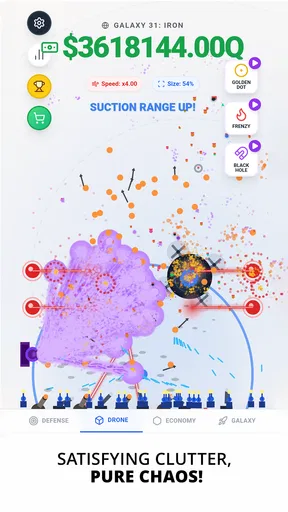
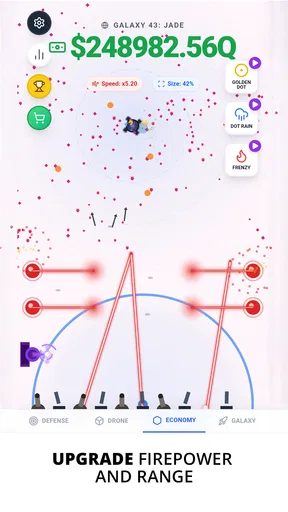
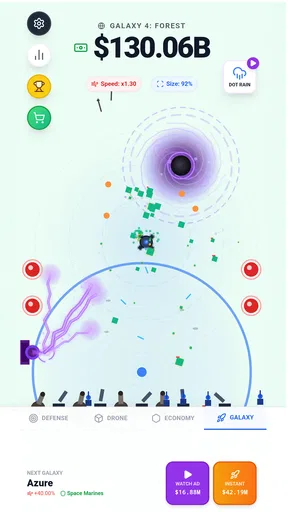
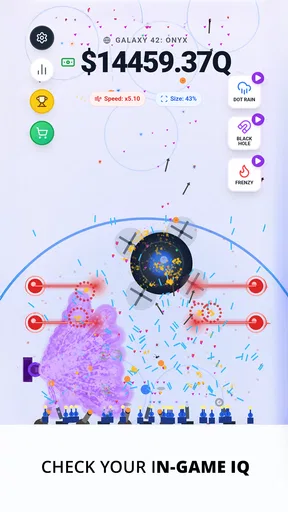
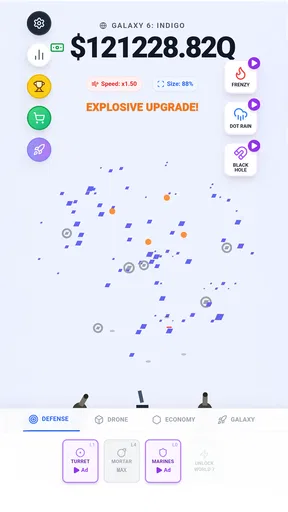
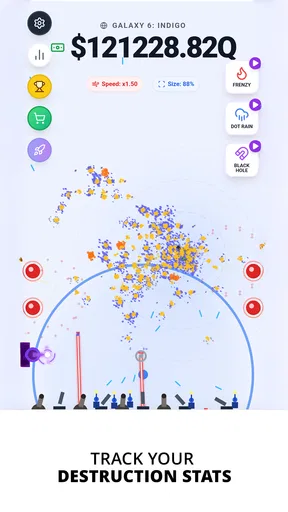
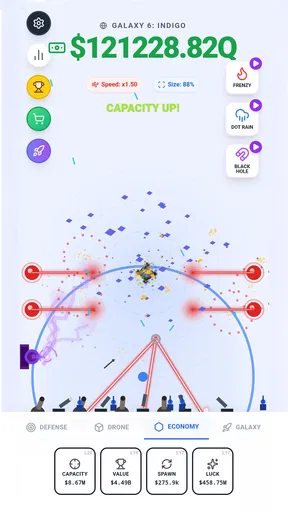
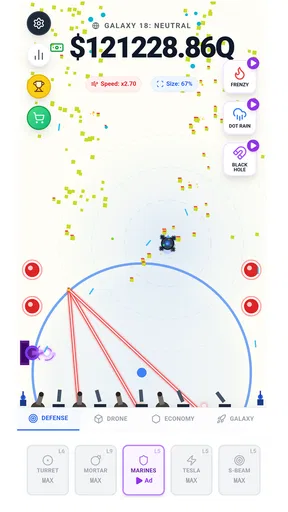
Our Review of Idle Dot Shooter!
 Analysis by Appyee
Idle Dot Shooter! is the kind of arcade game I can open with one hand, play for a few moments, and understand almost immediately. Its central idea is simple: dots are the targets, drones are the tools I improve, and progress comes from making the shooting setup more effective over time. That clarity is its biggest strength. I do not need a long tutorial or a quiet hour before I can enjoy it.
After spending time with it, I see a game built less around dramatic action and more around a steady loop of watching progress, making upgrades, and deciding whether to continue for another short session. That makes it a natural fit for waiting rooms, commutes, or the few minutes before bed. It also creates the main question I kept returning to: is the satisfaction of improving a small automated system enough to carry the experience once the first novelty fades?
Why the first few minutes work so well
The opening appeal is immediate because the game does not ask me to learn a complicated control scheme. I can focus on the moving targets, observe the drones doing their work, and look for the next useful improvement. That directness matters in an arcade game intended for quick access. There is little friction between launching the app and understanding what I am supposed to do.
I especially like that the game’s basic fantasy is easy to read on a small phone screen. Dots provide a clear visual goal, while the drones give the progression a visible purpose. Even without treating every moment as an intense challenge, I can see why a player would want to check back in: the screen communicates whether the setup is becoming more efficient.
The developer, Infinity Games, Lda, has positioned this as an idle space shooter rather than a traditional reflex-heavy shooter. That distinction is important. I would not choose it when I want precise aiming, enemy patterns, or a demanding arcade test. I choose it when I want the feeling of building momentum without having to perform perfectly every second.
That also explains why the game can be appealing to people who normally avoid arcade titles. The familiar shooting theme is present, but the experience is gentler than a game that expects constant tapping or rapid reactions. The first session gives enough direction to form a routine: watch the action, collect the benefits of progress, and spend improvements where they seem most useful.
My practical advice is to resist treating every available improvement as automatically valuable. The more useful question is what will make the next short session feel better. If a stronger drone helps the screen feel more active, that may be preferable to an upgrade that looks impressive but does not change the rhythm I enjoy. This is a small distinction, but it turns the game from passive watching into a series of personal choices.
A rhythm designed for interruptions
The strongest part of the experience is its tolerance for divided attention. I can start a session while waiting for a kettle to boil, glance back after answering a message, and still understand what has changed. That is a better match for everyday mobile play than games that punish every interruption with a failed run or lost concentration.
In my experience, the best sessions are not necessarily the longest ones. A short visit gives me time to check progress, make one or two decisions, and leave with the sense that the account has moved forward. The game’s idle structure supports that pattern because it does not require me to remain locked into the screen from beginning to end.
There is a trade-off, though. Interruption tolerance can reduce urgency. If I enjoy games because of pressure, precise timing, or the need to protect a run, this may feel too relaxed. The dots and drones create activity, but the pleasure comes from gradual improvement more than from surviving a difficult encounter.
I also found that the game works best when I give each visit a small purpose. I might return to improve one drone, check whether a new level of efficiency is possible, or see how far the current setup has climbed. Without that intention, the loop can become a quick glance followed by another quick glance, with less reason to stay.
For a realistic daily example, I could open it during a ten-minute lunch break. I would not need to remember a complicated mission or rebuild a strategy from scratch. I could inspect the current state, make a targeted upgrade, watch the result for a while, and close the app when work calls me back. That kind of predictable entry and exit is where the game feels most comfortable.
Returning later without losing the thread
Idle games live or die by how easy they are to resume. Here, the core idea is simple enough that I can return after a gap without feeling lost. I do not need to reconstruct a long narrative or remember a complicated chain of objectives. The drones, dots, and upgrade path provide the context I need.
That makes it suitable for players who prefer a game that can sit alongside other activities. I can treat it as a small routine rather than a main event. The global leaderboard adds another reason to check back, particularly if I enjoy comparing progress with a wider player base instead of keeping the experience entirely private.
At the same time, leaderboard motivation will vary sharply from person to person. If rankings make me want to optimize, the game has an extra layer beyond simply watching numbers rise. If I do not care about competition, the leaderboard is more of a background feature than a reason to install. I would not recommend downloading it solely for competitive depth; its more dependable appeal is the personal upgrade loop.
One useful habit is to decide in advance whether I am playing for relaxation or optimization. For relaxation, I can choose improvements that make the screen feel satisfying and leave whenever I want. For optimization, I need to pay closer attention to which upgrade changes the pace of progress most meaningfully. Mixing those goals can make the game feel less rewarding, because the choice that looks fun is not always the choice that seems efficient.
The game’s current version is 31.2.2, and it runs on Android 7.0 or later. That broad compatibility makes it easier to consider on an older Android phone, although the actual comfort of play will still depend on the device’s screen and performance. I appreciate that the minimum system requirement does not push the game toward only recent hardware.
Where the repetition helps and where it wears thin
Repetition is not a flaw by itself in an idle arcade game. Repeating a clear action can be calming, especially when each return produces a visible improvement. The loop here has a pleasant simplicity: targets appear, drones attack, and I look for the next step in the upgrade process. When I am in the mood for low-pressure progress, that is enough.
The limitation is that the same simplicity can narrow the experience over time. Players who need frequent surprises, changing objectives, or a deep tactical system may find the routine predictable. I would not describe this as a game that constantly reinvents itself. Its replay value depends heavily on whether I enjoy incremental progress and the personal challenge of making the setup more effective.
That is why I would compare it with the usual alternatives carefully. A conventional arcade shooter is better when I want direct control, quick reactions, and a clear test of skill in each round. A larger idle game may be better when I want several interconnected systems, more planning, or a broader sense of long-term management. Idle Dot Shooter! sits between those choices: it borrows the visual language of shooting while keeping the interaction lighter and more automated.
Its advantage over a reflex shooter is that a distracted player can still enjoy it. Its advantage over a sprawling idle game is that the rules are easier to hold in my head. The cost is equally clear: it may not offer enough variety for someone who wants a constantly changing challenge. I see that as a deliberate trade-off rather than a failure, but it should shape expectations before downloading.
A second practical tip is to use the game as a short-session habit instead of forcing marathon play. When I stay longer than the loop naturally supports, I become more aware of the repetition. When I return for a focused check-in, the same mechanics feel cleaner and more satisfying. This is one of those games where stopping at the right moment can improve my impression of it.
The visual and mechanical clarity also makes it a reasonable choice for casual players who dislike clutter. I can understand the purpose of the screen without studying several menus first. That does not mean every decision is automatically meaningful, but it does mean the game respects the limited attention I usually have when playing on a phone.
Free access and the question of spending
The game is free to play, which lowers the risk of trying it. I can install it, spend a few short sessions with the dot-shooting loop, and decide whether the upgrade rhythm fits me before committing anything. For this type of arcade title, that trial-friendly approach makes sense because the appeal is personal: some players will enjoy the calm automation, while others will quickly want more variety.
Optional purchases range from $0.99 to $99.99 per item. That is a wide span, so I would approach the purchase system with a clear personal limit rather than buying impulsively whenever progress slows. The core question is not whether spending can make advancement feel faster; it is whether faster advancement would actually make the game more enjoyable for me.
I would be particularly cautious if I tend to turn small mobile purchases into a habit. The game’s loop is built around wanting the next improvement, which can make an upgrade feel urgent even when it is not necessary. My preferred approach is to play free for several sessions first, learn whether the repetition holds my attention, and only then consider whether any optional purchase adds genuine convenience.
This is also where the game may be less suitable than a simple premium arcade title for some people. If I want a completely fixed experience with no purchase decisions, a paid alternative may feel more comfortable. If I am happy to try a free game and ignore optional spending, the entry point is much easier.
Who will enjoy it most
I think the best audience is someone who likes visible progress but has an unpredictable schedule. The game fits short breaks, small daily routines, and moments when I want something more engaging than scrolling but less demanding than a full action game. It is also a good match for players who enjoy improving a system and watching that improvement work without needing constant manual input.
It can suit a younger audience as well, since the content rating is Everyone. I would still make the decision based on the individual player’s response to optional purchases and leaderboard competition, but the accessible presentation makes it approachable for a broad range of ages.
Players who should probably skip it are those looking for a story, demanding controls, or a deep campaign structure. I would also hesitate to recommend it to anyone who becomes bored by repeated upgrade loops. The game does not hide what it is: a compact arcade experience centered on dots, drones, and gradual progress. If that foundation does not sound appealing, later upgrades are unlikely to change the basic nature of the experience.
Another group that may want a different option is competitive arcade fans who measure enjoyment through personal skill. The global leaderboard can add motivation, but it does not transform the game into a precision contest. My own enjoyment comes more from making sensible improvements and checking the result than from proving that I can react faster than everyone else.
My casual verdict after living with the loop
With an average rating of 4.4 from around 16 thousand ratings and more than a million installs, the game has clearly found an audience for this compact style of play. Those figures do not guarantee that it will suit every player, but they match my impression that its straightforward loop is easy to approach and easy to fit into a day.
I would recommend it to a friend who wants a free arcade game for brief visits, especially if that friend enjoys idle progression and does not need constant novelty. The immediate pleasure is real: I can open it, recognize the goal, make a change, and see the shooting setup continue to develop. That is a satisfying package when my attention is limited.
My reservations are just as straightforward. The experience can become repetitive, leaderboard motivation is optional rather than universal, and the broad in-app purchase range deserves deliberate handling. I would not present it as a replacement for a skill-based shooter or a large management game. It is better understood as a lighter middle ground.
In the end, Idle Dot Shooter! succeeds when I treat it as a small, interruption-friendly arcade ritual rather than a game that must occupy an entire evening. Its best quality is the clean connection between a quick visit and a feeling of progress. If that is what I want from mobile play, Infinity Games, Lda has made an easy recommendation. If I need variety, pressure, or a richer structure, I would look elsewhere.
Verdict
Strengths of Idle Dot Shooter!
- Simple one-touch controls make it easy to play casually.
- Idle rewards let progress continue even during short breaks.
- Bright dot-based visuals keep the screen clear and readable.
- Upgrade choices provide a steady sense of progression.
- Runs smoothly on most modern Android and iOS devices.
Limitations of Idle Dot Shooter!
- Gameplay can become repetitive after extended sessions.
- Progress may feel slow without watching ads or spending resources.
- Limited strategic depth may disappoint experienced shooter players.
- Frequent ad prompts can interrupt the relaxed idle experience.
- The minimalist presentation offers little variety in environments or enemies.
Other Releases by Infinity Games, Lda
View All
Traffix: Traffic Simulator
Simulation4.6

Enigmic: Crime Puzzle Cases
Puzzle4.5

Package Inc - Management Games
Simulation4.3
Similar Picks in This Category
View All
Subway Surfers
SYBO Games4.6

Stickman Party 234 MiniGames
PlayMax Game Studio4.6

Subway Princess Runner
Ivy4.4

Temple Run
Imangi Studios4.2

Zombie Tsunami
Mobigame SAS4.6

Stack Ball - Crash Platforms
CASUAL AZUR GAMES4.5
Frequently Asked Questions
What is Idle Dot Shooter?
Idle Dot Shooter is a casual idle arcade game focused on automatically firing at incoming targets. You guide or upgrade a small shooter while it attacks enemies, collects rewards, and progresses through increasingly difficult stages. Its simple controls make it easy to play in short sessions, while the upgrade system gives you reasons to return and improve your damage, firing speed, and overall performance.
How do you play Idle Dot Shooter?
The game is designed to be straightforward for beginners. Your shooter attacks automatically, and your main task is usually to manage movement, positioning, upgrades, or other available abilities depending on the stage. Defeating targets earns resources that can be spent on improvements. Even when you are not actively playing, idle rewards may help your progress, so checking in regularly is useful.
Does Idle Dot Shooter work without an internet connection?
Some parts of Idle Dot Shooter may be playable offline, particularly basic shooting and previously unlocked progression. However, features such as advertisements, cloud saving, special events, leaderboards, purchases, or reward claims may require an internet connection. Because offline availability can vary between versions, it is best to check the game’s store description and test its main features after installation.
Is Idle Dot Shooter free to download and play?
Idle Dot Shooter can generally be downloaded for free, allowing you to try the core gameplay without paying upfront. Like many idle and arcade titles, it may include optional advertisements and in-app purchases for extra currency, boosts, or convenience. You can normally progress without spending money, but patience may be required because upgrades and rewards can take longer to obtain.
Is Idle Dot Shooter suitable for children and casual players?
The simple controls and colorful arcade-style gameplay make Idle Dot Shooter accessible to casual players and younger audiences. Nevertheless, parents should review the age rating, advertising content, privacy information, and available in-app purchases before allowing children to play. If the game offers purchases or frequent video rewards, enabling device-level purchase restrictions is a sensible precaution.
Play our best games!


